-

Sails: The Egg Saga
The Egg Saga is a humorous fiction story recounting the time when Jim and his friend Charlie found an enormous egg on an island. The egg turned out to be extremely rare and valuable. Instead of...
-

Sails: The Egg Saga (1st edition)
The Egg Saga is a humorous fiction story recounting the time when Jim and his friend Charlie found an enormous egg on an island. The egg turned out to be extremely rare and valuable. Instead of...
-

Sails: The Monsters of Burwood
Monsters of Burwood is a fictional text that outlines the various rules that these monsters live by. These rules include rules about how to eat, where to live, how to be a good monster, and how to...
-
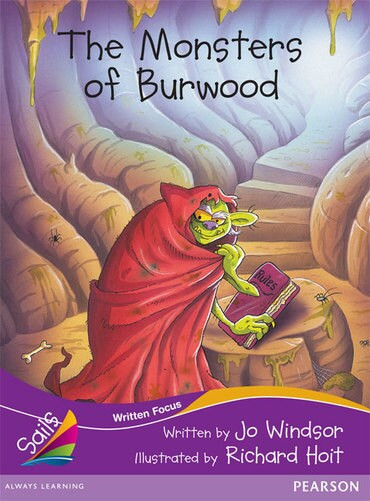
Sails: The Monsters of Burwood (1st Edition)
Monsters of Burwood is a fictional text that outlines the various rules that these monsters live by. These rules include rules about how to eat, where to live, how to be a good monster, and how to...
-

Sails: The Zachary's Plans (1st Edition)
The Zacharys’ Plans is a narrative story about a couple who are trying to build a house but cannot decide on a plan. The book also discusses features of a description. The story unfolds in first -...
-

Same, but Different
Same, but Different is an expository text about animals that look the same and different. Readers learn about butterflies and moths, frogs and toads, and turtles and tortoises. Illustrations enhance...
-

Saving Zoop
Saving Zoop is a realistic narrative about a boy who catches an otter because he thinks the otter’s river is too muddy. After storing him in his shed, he realizes that his plan is killing the otter...
-
Scarecrow's Hair
Scarecrow’s Hair Scarecrow’s Hair is a lighthearted fantasy about a scarecrow who is sad because he has no hair and a farmer who goes to great lengths to make his scarecrow happy. The story is told...
-

Science Readers: Adaptations
Adaptations is an expository text that explains how animals adapt and change over time as conditions change. An activity invites students to explore how blubber works. The book is divided into...
-

Science Readers: All in the Family
Learn all about traits and how they make you who you are! Discover how shared traits make offspring look like their parents. While members of the same species may look alike because of their common...
-

Science Readers: Analyze It!
Analyze It! is an informational text that explains the scientific method including forming a question, researching, creating a hypothesis, conducting an experiment, recording and analyzing data,...
-

Science Readers: Animal Senses
Animal Senses is an expository text that explains how animals use their senses, often in ways very different from how humans do. An activity invites students to explore how the shape of an animal’s...